
Showing posts with label News. Show all posts
Showing posts with label News. Show all posts
Wednesday, March 29, 2017

Friday, February 17, 2017
Animal friendly Six-Pack Holders
Saltwater Brewery a craft brewing company in Florida promotes lifestyle that revolves around the ocean. Their goal is to maintain the world’s greatest wonder by giving back to the ocean through Ocean Based Charities (CCA, Surfrider, Ocean Foundation, MOTE).
"Our passion for making Quality Beer for you is the way we can ensure we give back to the ocean as much as possible! Come with us to "Explore the Depths of Beer","
Most plastic beer six‐pack rings end up in our oceans and pose a serious threat to wildlife. Together with WeBelievers, Saltwater Brewery ideated, designed, tested and prototyped the first ever Edible Six Pack Rings. A six‐pack packaging, made with byproducts of the beer making process, that instead of killing animals, feeds them. They are also 100% biodegradable and compostable.
If you see one let us know and spread the word on this great idea
http://www.saltwaterbrewery.com/home/
"Our passion for making Quality Beer for you is the way we can ensure we give back to the ocean as much as possible! Come with us to "Explore the Depths of Beer","
Most plastic beer six‐pack rings end up in our oceans and pose a serious threat to wildlife. Together with WeBelievers, Saltwater Brewery ideated, designed, tested and prototyped the first ever Edible Six Pack Rings. A six‐pack packaging, made with byproducts of the beer making process, that instead of killing animals, feeds them. They are also 100% biodegradable and compostable.
If you see one let us know and spread the word on this great idea
http://www.saltwaterbrewery.com/home/
Wednesday, January 25, 2017
Science is not bent to one man's will.
It can not lie follow the movement and keep the truth free. Follow the link below to know to see where the blacked out agencies have gone.

https://twitter.com/StollmeyerEU/lists/twistance/members
https://twitter.com/StollmeyerEU/lists/twistance/members
Monday, October 24, 2016
How a Band of Marine Researchers Is Solving the Plastic Pollution Crisis in Our Oceans
 Algalita's Ship-2-Shore education program aims to demystify recycling. Image courtesy Algalita.
 Algalita’s executive director, Liesl Thomas, carries on Captain Moore’s vision of collaboration. “It was always his mentality that if anything is going to get solved, it will be by people working together,” she says from her office in Long Beach.
 Liesl Thomas
Executive Director, Algalita
On the recycling education front, Algalita has partnered with the nationwide program Recycle Across America, whose goal is to get standardized recycling labels on all recycling bins across the country.
Read more
Friday, October 14, 2016
The Great Barrier Reef of Australia passed away in 2016 after a long illness.
It was 25 million years old
A scientist who recently visited the Great Barrier Reef has said "if it was a person, it would be on life support", as researchers strive to highlight the plight of the reef.
New images have shown the worrying extent of the damage done to the reef by climate change.
A scientist who recently visited the Great Barrier Reef has said "if it was a person, it would be on life support", as researchers strive to highlight the plight of the reef.
New images have shown the worrying extent of the damage done to the reef by climate change.
Rising water temperatures have damaged the world’s largest reef system, which stretches for over 1,400 miles off the coast of Australia.
read more
read more
There are other reports that there is still hope
The news isn’t good, but it may not be as dire as the obituary may have you believe.
“For those of us in the business of studying and understanding what coral resilience means, the article very much misses the mark,” said Kim Cobb, a professor in Georgia Tech’s School of Earth and Atmospheric Sciences. “It’s not too late for the Great Barrier Reef, and people who think that have a really profound misconception about what we know and don’t know about coral resilience.”
Monday, October 3, 2016
What is believed to be the oldest white oak tree in the country is dying
BERNARDS — What is believed to be the oldest white oak tree in the country, one that has called Basking Ridge home for more than 600 years, may have dropped it's last leaves
Old Oak Tree[edit]

In the historical graveyard of the church stands a White Oak, sometimes called the "Holy Oak".[4] It is 600 years old, possibly the oldest white oak in the world.[4] It is nearly 100 feet (30 m) tall and has a spread of more than 130 feet (40 m).[5] It has a trunk circumference of 20 feet (6.1 m) and its lower branches are supported.
English evangelist George Whitfield and American clergyman James Davenport, preached under the tree on November 5, 1740 to a crowd of 3,000, in the First Great Awakening.[3][5]
George Washington's troops were drilled on the village green, within view, and G.W. picnicked under the tree with the Marquis de LaFayette.[5]
The 5,500 French troops of Jean-Baptiste Donatien de Vimeur, comte de Rochambeaumarched by in 1781, on their route to Yorktown, Virginia and the decisive battle of theAmerican Revolutionary War.[5]
In 2016, the tree is "failing to thrive"[5] and shows signs of distress as its upper parts failed to sprout leaves.[4]
Jon Klippel, a member of the church's Planning Council, said Tuesday that residents were hoping the treasured tree would spring to life once the weather warmed, but it hasn't.
"It has put out leaves in its lower portion this spring, but its upper portion, the crown of the tree, has not put out new leaves," said Klippel. "An oak tree tends to hold onto its leaves through the winter and then a growth spurt will push off the older leaves early in the spring. Read more
Monday, September 5, 2016
Good summer for pandas

A surprise pare of twin pandas were born in Atlanta GA in July and now The official status of the much-loved animal has been changed from "endangered" to "vulnerable" because of a population rebound in China. They are not out of the woods yet and it will probably take a few lifetimes before we can count them safe.
Friday, September 2, 2016
Millions of honey bees are being killed because if the strong measures being taken to stop the spread of Zika through the mosquito population in South Carolina.

"On Saturday, it was total energy, millions of bees foraging, pollinating, making honey for winter," beekeeper Juanita Stanley said. "Today, it stinks of death. Maggots and other insects are feeding on the honey and the baby bees who are still in the hives. It's heartbreaking."
"Those that didn't die immediately were poisoned trying to drag out the dead," Stanley said. "Now, I'm going to have to destroy my hives, the honey, all my equipment. It's all contaminated." Source cnn
This could have been prevented with a warning that spraying was going to happen. Even the firechief and hobbyist beekeeper did not know spraying was going to happen. Is this a poor communication error or a tactic to avoid a deley by proponents to spraying.
Hearing reports on my local radio WBZ it is happening in all areas Spraying is effective but blanketing instead of organizing a ground crew without warning is also harmful to our ecosystem and peoples health who are sensitive to this. There are other officials who seem like the mayor in Jaws putting health at risk to keep tourists coming by downplaying the dangers in the area. Contact your local and state authority people must know what is happening before another massacre.

"On Saturday, it was total energy, millions of bees foraging, pollinating, making honey for winter," beekeeper Juanita Stanley said. "Today, it stinks of death. Maggots and other insects are feeding on the honey and the baby bees who are still in the hives. It's heartbreaking."
"Those that didn't die immediately were poisoned trying to drag out the dead," Stanley said. "Now, I'm going to have to destroy my hives, the honey, all my equipment. It's all contaminated." Source cnn
This could have been prevented with a warning that spraying was going to happen. Even the firechief and hobbyist beekeeper did not know spraying was going to happen. Is this a poor communication error or a tactic to avoid a deley by proponents to spraying.
Hearing reports on my local radio WBZ it is happening in all areas Spraying is effective but blanketing instead of organizing a ground crew without warning is also harmful to our ecosystem and peoples health who are sensitive to this. There are other officials who seem like the mayor in Jaws putting health at risk to keep tourists coming by downplaying the dangers in the area. Contact your local and state authority people must know what is happening before another massacre.
Monday, June 6, 2016
Finding Dory will make the blue tang fish popular and that’s not a good thing
I was working in a pet store during the Nemo craze. It was painful how poorly educated people were on the care and ecosystem they need to survive. First you need to be 18 to buy a pet in my state or have an adult present.
A teenage girl came to me asking for a Nemo, red flag, so I ask what size is her tank etc.
"oh I have a old goldfish tank."
"how big is it?" measures out maybe a gallon with her hands
"that is not big enough"
I then go into how you set up a saltwater tank the sizes you need tests needed and how you need to have it run for a certain amount of time to get everything ok.
"oh I was just going to add salt to the water"
"and you'll kill Nemo in 20 minuets"
huffy face
"we also do not do returns on saltwater fish because they are so fragile and die easily" pointed to the sign for emphasis.
That stopped her
When Pixar’s Finding Nemo
was released in 2003, it unleashed a tidal wave of demand for the cute
orange clownfish, the species that the character Nemo is based on. Sales
of clownfish rose as much as 40%, according to some estimates. Some
scientists were concerned that the population of the fish would be
severely depleted if too many were caught in the wild. Aquarists,
however, soon figured out how to breed clownfish in captivity, reducing
the impact of lots of them being taken from coral reefs.
Now, scientists are bracing for Nemo’s sequel, Finding Dory, which will be released on June 17. Dory is a blue tang.
Unlike the clownfish, scientists and aquarists have not been able to
breed the blue tang in captivity so far. That’s led to worries that now
this species could face severe pressure from overcollecting on reefs
(primarily in the Indo-Pacific, one of the world’s top sources for wild
tropical fish), if movie viewers turn out to be as interested in owning
pet blue tangs as they were in owning clownfish.
One animal rights group is petitioning
the Walt Disney Company to put out a public service announcement asking
people not to buy the fish. Their petition cautions, “If Disney does
not place an explicit warning at the beginning of the film asking
viewers not to adopt Blue Tang like Dory, then we will see a sharp
decline in their population.”Origiinal link
http://qz.com/694462/finding-dory-will-make-the-blue-tang-fish-popular-and-thats-not-a-good-thing/
Friday, May 20, 2016
Portugal runs for four days straight on renewable energy alone
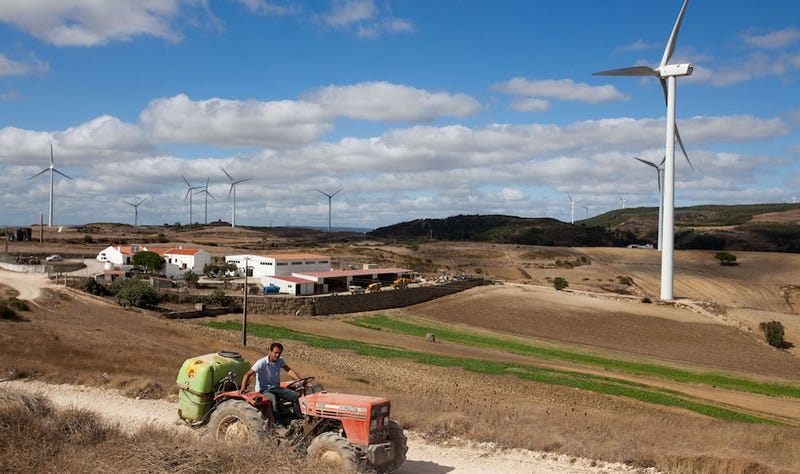
Electricity consumption in the country was fully covered by solar, wind and hydro power in an extraordinary 107-hour run that lasted from 6.45am on Saturday 7 May until 5.45pm the following Wednesday, the analysis says.
News of the zero emissions landmark comes just days after Germany announced that clean energy had powered almost all its electricity needs on Sunday 15 May, with power prices turning negative at several times in the day – effectively paying consumers to use it.
READ MORE
Arthur Neslen
News of the zero emissions landmark comes just days after Germany announced that clean energy had powered almost all its electricity needs on Sunday 15 May, with power prices turning negative at several times in the day – effectively paying consumers to use it.
READ MORE
Arthur Neslen
Friday, January 22, 2016
Long Thought To Be Extinct, Bizarre Tree Frog Surfaces In India
For nearly 150 years, a bizarre tree frog species in India was believed to be extinct.
 Now, scientists have found the elusive Frankixalus jerdonii in India's West Bengal state, in the foothills of the Himalayas.
Last seen in the wild in 1870, the frogs were rediscovered by accident during a 2007 expedition led by Indian biologist Sathyabhama Das Biju. "We heard a full musical orchestra coming from the tree tops. It was magical. Of course we had to investigate," he told the BBC.
What's more, a subsequent study published this week by Biju and a team of researchers looks at the frog's "enigmatic lineage," and concludes that the amphibian represents an entirely new genus.
The study's co-author Ines Van Bocxlaer tells National Geographic that "the frog's DNA, odd feeding behavior and anatomy shows the species 'represents a deep evolutionary split in tree frog evolution.' "
That led scientists to change the frog's name from the original, Polypedates jerdonii,to Frankixalus jerdonii to reflect the new genus.
"Most tadpoles of other frog species eat plant material," National Geographic says. Not the Frankixalus jerdonii. Here's how National Geographic describes what happens after the female lays eggs inside tree holes:
"Females attach their eggs to the insides of tree hollows, which hold pools of water. When the tadpoles hatch, they fall in the water, where the females feed them unfertilized eggs until they turn into froglets."
The tadpoles each had "3-19 eggs in their intestines," the study says. And unusually, these tadpoles do not have tooth rows, which differentiates it from similar species.
There are a few theories about how the tree frogs stayed hidden for nearly 150 years, the BBC reports.
"The golf ball-sized frog lives in tree holes up to 6m (19 feet) above ground, which may have helped it stay undiscovered," the BBC says, "although other scientists have suggested it may have gone unnoticed simply because there are so few scientists working in the remote region."
But its survival is uncertain. Citing "alarming" threats, the study says that multiple areas where the species is believed to live are disturbed by slash-and-burn deforestation.
Subscribe to:
Posts (Atom)